
Guide to Our Service
So you’re new to Town and Country. Don’t worry — liturgical worship isn’t as confusing as it might look. This page is a brief guide to our hymnal, The Lutheran Service Book, and to a typical Divine Service.
But all things should be done decently and in order.
1 Corinthians 14:40
If at any point you need further clarification, please speak with the pastor or one of our elders before or after the service. They’ll be happy to help.
Finding Your Place — The Sections of the Hymnal
The Lutheran Service Book contains a great deal about our confession of faith. For today’s service, the three main sections you need are the Psalms, the Divine Service, and the Hymns:
- 100–150 — Psalms
- 151–218 — Services
- 331–1023 — Hymns
If you have time, explore the rest. A useful section for understanding what Lutherans believe begins on page 321, The Small Catechism. There are also prayers in the front.
Marking Your Place — Order of Service and Hymns
Before the service starts, you may find it helpful to mark your hymnal with the ribbons. The bulletin tells you which Order of Service and which Psalm will be used, and the bulletin itself makes a fine extra bookmark.
Almost every service begins with a hymn. The page number will be in the bulletin and on the number board up front. If you’re unfamiliar with singing from sheet music: we sing the first line of each stanza, then the second, and so on.
Screen Up Front
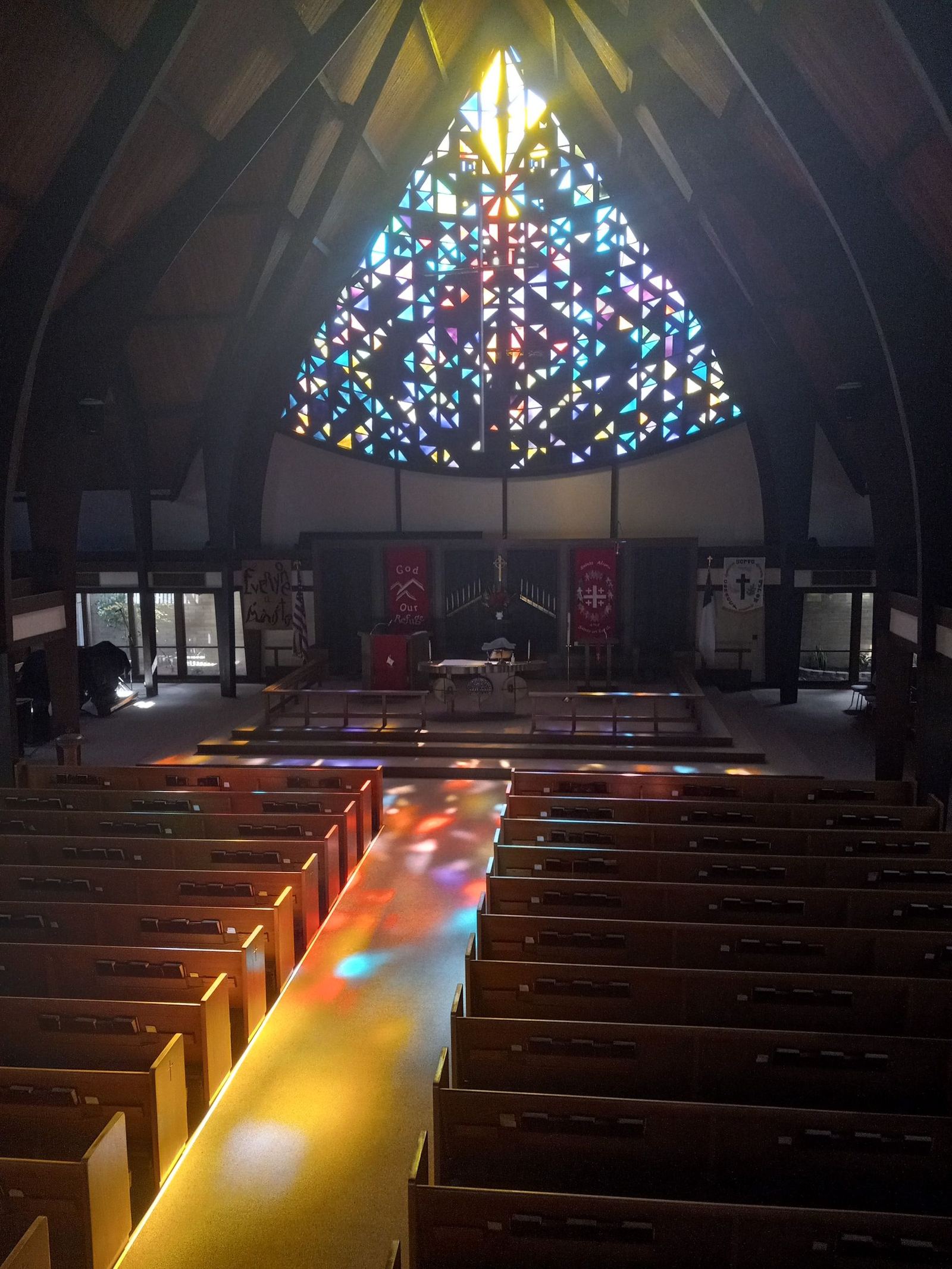
The service is also projected at the front of the sanctuary. So if you get lost, just look up.
Elements of the Divine Service
Invocation and the Sign of the Cross
At the beginning of the Divine Service, the Invocation calls upon God’s name and shows us that this is His service to us, not ours or someone else’s. During the Invocation the pastor reminds us of our own Baptism by making the sign of the cross, which is where we first received it. You and those around you may also desire to make the sign of the cross to remember your Baptism.
Confession and Absolution
During the Confession of Sins we acknowledge that we are sinful by nature and by our actions, and therefore fail to meet God’s righteous judgment against us. But the Lord is present with us, and because He has conquered sin, death and the devil through His death and resurrection, we receive the forgiveness of our sins.
Through the mouth of God’s servant, the pastor, our Lord declares His grace and mercy to us and that our sins are forgiven. The Absolution speaks the Gospel to us in a very personal way. The pastor does have the authority, given by Christ, as one called by God and ordained through the Church, to speak God’s word of forgiveness to the repentant sinner in the stead and name of Christ.
The Service of the Word
This is the portion of the service where the risen Christ comes to teach us through His Word. It holds to the traditions of the ancient Church’s worship, centered on the reading of the Scriptures. The public reading of the Scriptures and the proclamation of the Word is at the heart of our service. The foundation of our faith is that the Word of God alone raises us up to be the children of God.
The Introit: “To Enter”
The Introit is a collection of passages from the Psalms that sets the tone for the service. It may be sung or spoken by the choir, the people or the pastor, and sometimes responsively.
You’ll notice that during the Introit the pastor may make his way from outside the communion rail to the altar area. Since Introit means “to enter,” this movement depicts the entrance into the Holy of Holies — the place in the Old Testament where God’s presence dwelled. Today God’s gracious presence is in the meal of Jesus’ body and blood.
Kyrie
The first prayer of the congregation is the Kyrie. It is a deep cry for mercy. We are beggars before God. We cry out because God has promised to hear us sinners and lavish His gifts upon us.
Hymn of Praise
Which Hymn of Praise we sing depends on the season in the church year. The congregation sings either the Gloria in Excelsis (Glory to God in the Highest) or This Is the Feast. During Advent and Lent the Hymn of Praise is omitted, because we are in a penitential season. You can tell it’s Advent or Lent because the color of the altar and the pastor’s stole is purple or blue.
The Scripture Readings
We read from the Old Testament, from an apostolic Epistle, and from the Gospel. In a very real way the Old Testament and Epistle readings find their fulfillment in the Gospel reading. The readings do this not by simply telling us about Jesus, but by giving us Jesus, who was crucified for our sins and raised from the dead so that we might be saved. The Word of God is the Word of life. You can read along on the back of the bulletin or the bulletin insert.
Hymn of the Day
The Hymn of the Day is the chief hymn of the Divine Service and keeps with the theme of the day. It also helps prepare our hearts for the sermon. The number is printed in the bulletin and on the number board up front. Remember: hymns are between pages 331 and 1023.
The Sermon
Our Lord sent His apostles into the world to preach the forgiveness of sins, the promise of eternal life, and our salvation found in Christ Jesus. In the sermon this same word is proclaimed to us today. The pastor’s sermon is the living voice of Christ proclaiming both Law and Gospel, usually from the appointed readings.
Creed
Having received the Word of the Lord, we respond by confessing our common Christian faith in one of the historic creeds. The word creed comes from the Latin credo, “I believe.” Through the Creed we express our unity of faith throughout the world and across the ages.
Prayer for the Church
In the Prayer for the Church we pray not only for our own needs but for the needs of our neighbor. This is the longest prayer of the service and may include prayers for the local congregation, the Church at large, right teaching, protection from the devil, the government, the military, all who suffer, the welfare and safety of ourselves and others, the conversion of unbelievers, and the restoration of those who have left the Church.
Offering and the Offertory
Just as we respond to hearing God’s Word in prayer and praise, we also respond in the Offering by returning to God a small portion of the gracious gifts He has bestowed on us. The Offertory is sung while the offerings are brought forward.
The Service of the Sacrament
The Service of the Sacrament is the celebration of the Lord’s Supper, instituted by Christ for the forgiveness of sins. During the Lord’s Supper we partake of Christ’s sacrifice and atonement in His true body and blood. Through this we are made one with Him and with all Christians throughout the world and all the saints who have gone before. This is why we call it Holy Communion.
Our Practice of Closed Communion
The historic and loving practice of closed communion means that confirmed members of The Lutheran Church—Missouri Synod are welcome to commune at this altar. We desire those who commune here to be under faithful pastoral care in our confession of faith.
Please know that our communion practice does not mean we are judging any individual Christian’s faith or salvation. But sadly not all Christian churches hold the same confession of faith. As a consequence of these divisions, we cannot extend a general invitation to receive the Lord’s Supper. Reception of Holy Communion by Christians who are not fully united with us in confession would imply a oneness which does not exist and for which we all pray. Closed communion is not about keeping people away from Jesus’ meal, but about helping people come to God’s altar with a full and rich understanding of what Christ gives in it. The pastor would be happy to speak with you about communing here in the future.
Distribution Hymn
During the distribution of the Lord’s Supper the congregation usually sings one or more hymns.
Lord’s Prayer
The Lord’s Prayer is the chief prayer of the Christian Church and was taught to us by Jesus in the sixth chapter of Matthew. For more, see page 323 of the hymnal.
Benediction
We end our service in the same manner we began — in the name of the Father, Son and Holy Spirit. Now the congregation departs in peace, reassured in the knowledge that their sins are forgiven.
More Information
If you have further questions, please speak with the pastor or one of the elders and they will be happy to assist you.
More about the Divine Service can be found in Worshiping with Angels and Archangels: An Introduction to the Divine Service. The pastor can get you a copy to borrow.